
 🥇 1st Place Techstars Startup Weekend 2025
BehavAI: Smarter Support for ABA Therapy
Co-founded an AI-powered platform to optimize behavioral data in Applied Behavior Analysis (ABA) therapy.


The Kickoff
We built a real startup powered by AI at Carnegie Mellon's renowned venture studio.
In a world of look-alike AI products and startups, clear purpose is hard to spot. I joined Carnegie Mellon's AI Venture Studio to learn how to ship something useful, using AI only when it removes friction and adds clarity.
We built a small team, chose a domain space, and started from zero. I scoped the problem, mapped the critical flows, and coded experiences for quick feedback, which set the course for our startup journey.
Me and my co-founder working hard (•̀ᴗ•́ )و
Choosing Our Domain
We chose behavioral healthcare, a field where therapists face relentless burnout and systemic stress.

After exploring several healthcare domains, we discovered Applied Behavior Analysis (ABA), a widely used, evidence-based therapy for autism and related conditions.
But the field is plagued by high burnout rates, minimal public recognition, and chaotic work environments.
We saw an opportunity to address these challenges through better tooling, giving therapists more time to focus on what matters most— their clients.
Meet Our Users
Designing for the therapists and supervisors who turn daily session work into life-changing outcomes.
Our primary focus are Board Certified Behavior Analysts (BCBAs) and Registered Behavior Technicians (RBTs), the providers who balance clinical oversight and direct intervention while navigating the operational realities that pull them away from client care.

Board Certified Behavior Analyst(BCBA)
Clinical supervisors who oversee treatment plans
Responsibilities:
- Analyze data from multiple RBT sessions
- Create progress reports for insurer authorization
- Make treatment adjustments based on outcomes

Registered Behavior Technician(RBT)
Front-line therapists delivering 1:1 ABA sessions
Responsibilities:
- Collect session-by-session behavioral data
- Track client progress on specific goals
- Document observations and interventions
The Core Problem
The tools meant to track progress have become the biggest obstacle to delivering care.
ABA therapy requires detailed session-by-session data collection to track client progress, yet the tools haven't evolved in decades. Providers face constant context switching that makes even simple tasks unnecessarily complex.
In a maze of disconnected touchpoints, it's time for something that truly connects care.

In-Session Time

EHR Systems

Paper Notes

Client Insights

Team Handoffs

In a maze of disconnected tools, it's time for something that truly connects care.
In-Session Time
EHR Systems
Paper Notes
Client Insights
Team Handoffs
Solution Preview
Introducing BehavAI, an AI layer that transforms scattered session data into structured, shareable progress reports.

Here's a sneak peek of the platform!
User Discovery
We studied ABA end-to-end so the product fits the work, not the other way around.
We shadowed an ABA practice, surveyed 150+ therapists, and conducted 15+ in-depth interviews to map how therapy data flows from RBT sessions to BCBA analysis to insurer reporting.





Landscape Analysis
Legacy systems were built for compliance, but they can't evolve fast enough.
We analyzed leading ABA practice management systems like CentralReach and RethinkBH alongside general-purpose AI tools such as ChatGPT.
Our goal was to find where an AI documentation layer could add value without forcing clinics to abandon their current infrastructure.
 |  |  |  | |
|---|---|---|---|---|
| ABA-specific documentation structure |  | |  | |
| AI assistance tailored to ABA reports | | | | |
| PHI-safe, HIPAA-aligned AI workflow | | | | |
| Works on top of existing systems | | | | |
| AI layer for practice-management & billing tools | | | | |
The Guiding Truth
Therapists needed support, not automation — so that's what we designed for.
We learned therapists don't want AI to take over, they want it to stay out of the way.
Every design choice focused on transparency and trust: clear structure, editable summaries, and straightforward tools that keep the therapist's voice front and center.


"I want an AI for notes because documentation NEVER ends. If someone makes robust tools for that, I'll 100% pay a ransom for it."

"I use ChatGPT all the time, but not for writing notes (...) you end up editing so much that it is not worth the time."

"AI is helpful for session notes (…) but I always have to remove identifying info first, which adds an extra step every time."

Design Constraints
Understanding the constraints of integrating AI into workflows that needed structure before automation.
ABA workflows are messy by necessity. Therapists juggle legacy systems, paper notes, and strict compliance rules while protecting client privacy. We needed to understand these constraints deeply before designing anything.
Legacy Systems

Built for billing and compliance, not modern workflows or AI integration.
Therapist Skepticism

AI-generated reports feel robotic and risk losing the therapist's authentic voice.
HIPAA & Privacy

Client data must stay protected, and public AI tools aren't an option.
Fragmented Data

Session notes, goals, and progress live scattered across different systems and formats.
Key Iterations
We explored different approaches to find the right balance between AI assistance and provider control.
Each iteration explored a different level of AI involvement in the documentation process. We tested approaches ranging from AI-led automation to provider-led collaboration, learning how much control therapists actually wanted.
Iteration 1: Live preview side-by-side AI generation
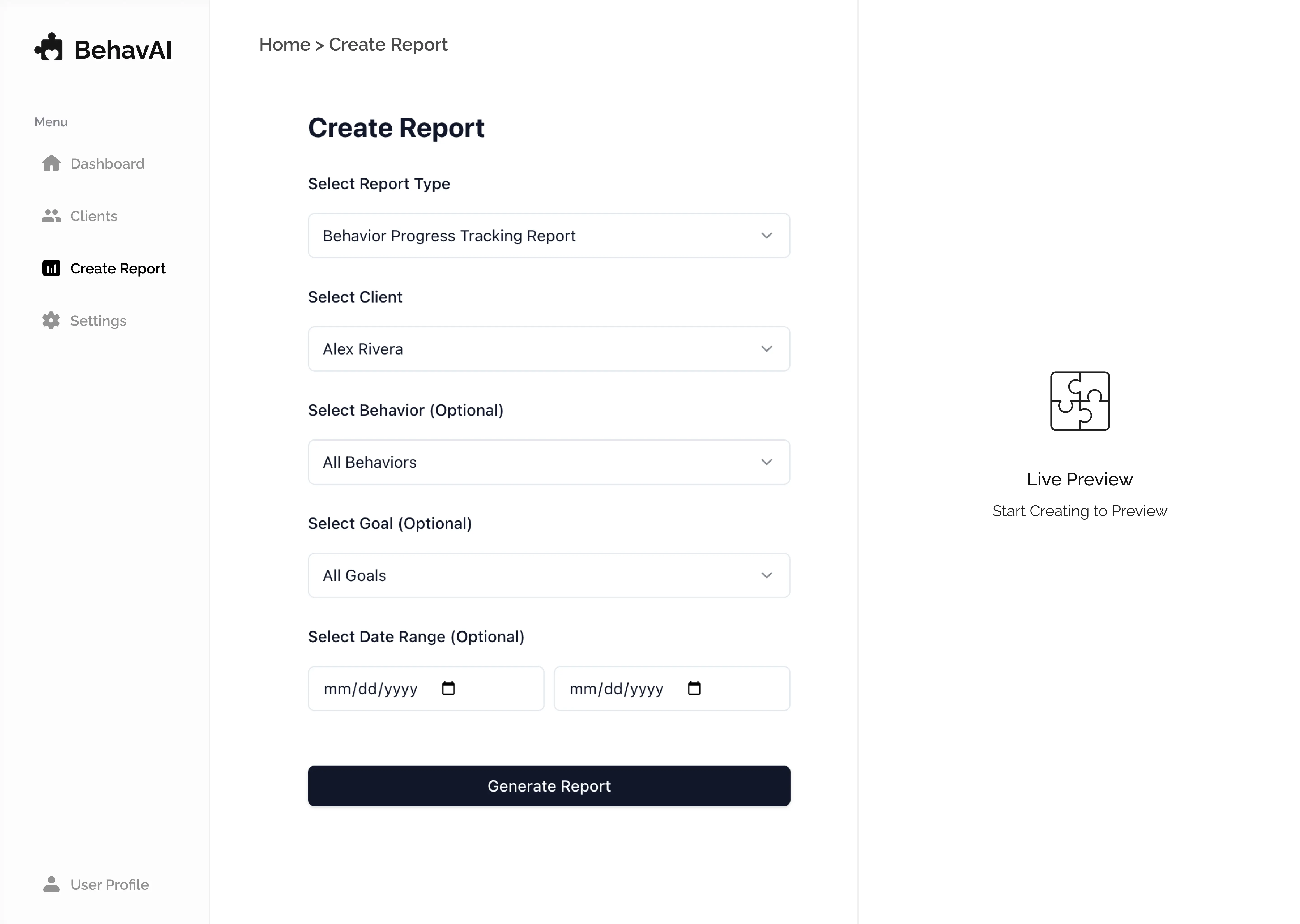
 Instant visibility into what AI is generatingTherapists can see and edit in real-time
 Providers felt like passive observers, watching AI work without being able to guide the outputClinical narratives lost their authentic voice and felt genericNo way for BCBAs to emphasize specific client progress or concerns
Iteration 2: Copilot for drafting and polishing reports
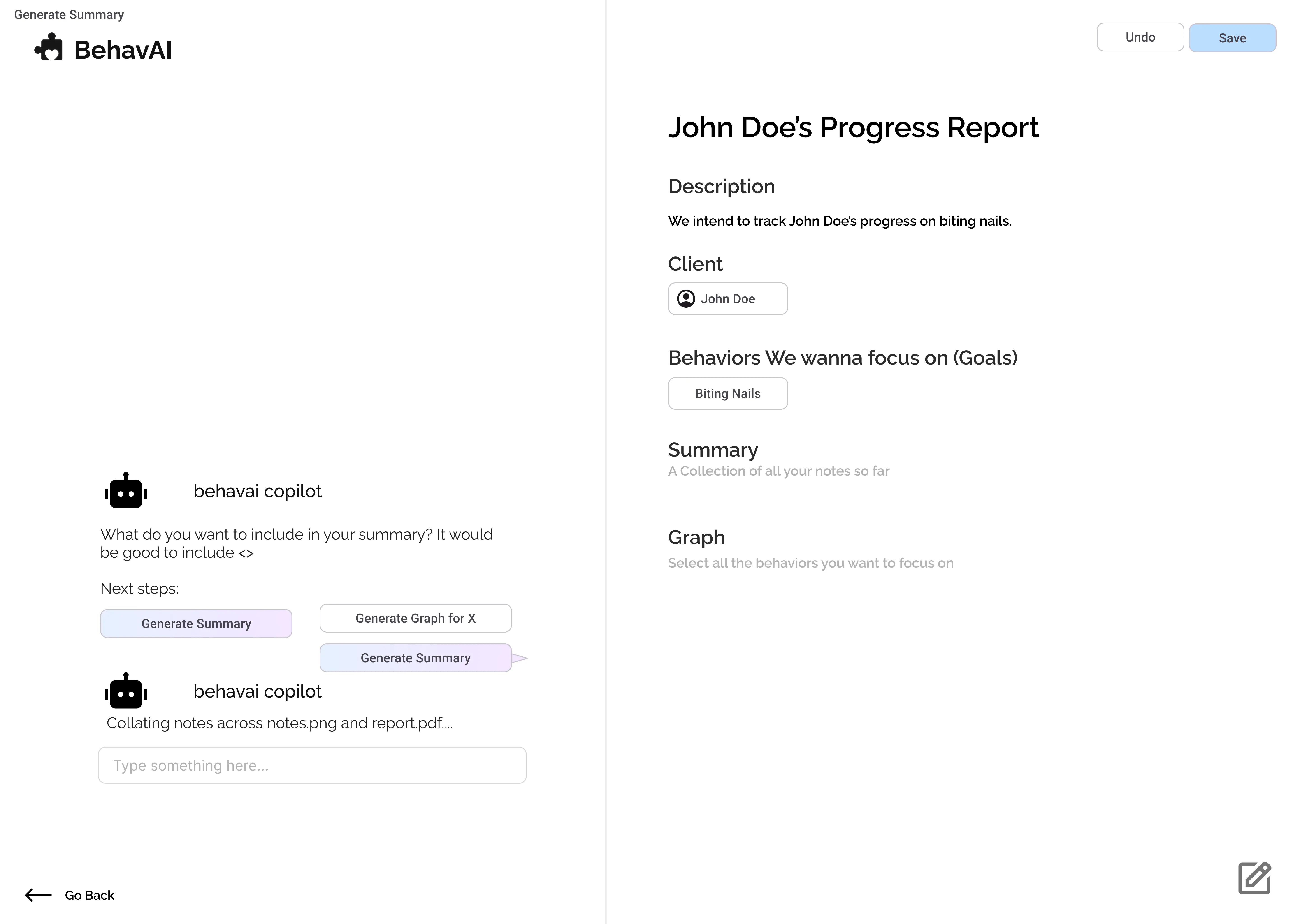 Gave therapists more agency, so they could ask for help when neededFlexible support without taking over the documentContext-switching between chat and document created cognitive overhead for BCBAsDifficult to prompt AI for the specific clinical language providers neededReports still required substantial editing to match their professional voice
Iteration 3: Dynamic modular cards with AI assist for creation and editing
Chosen Design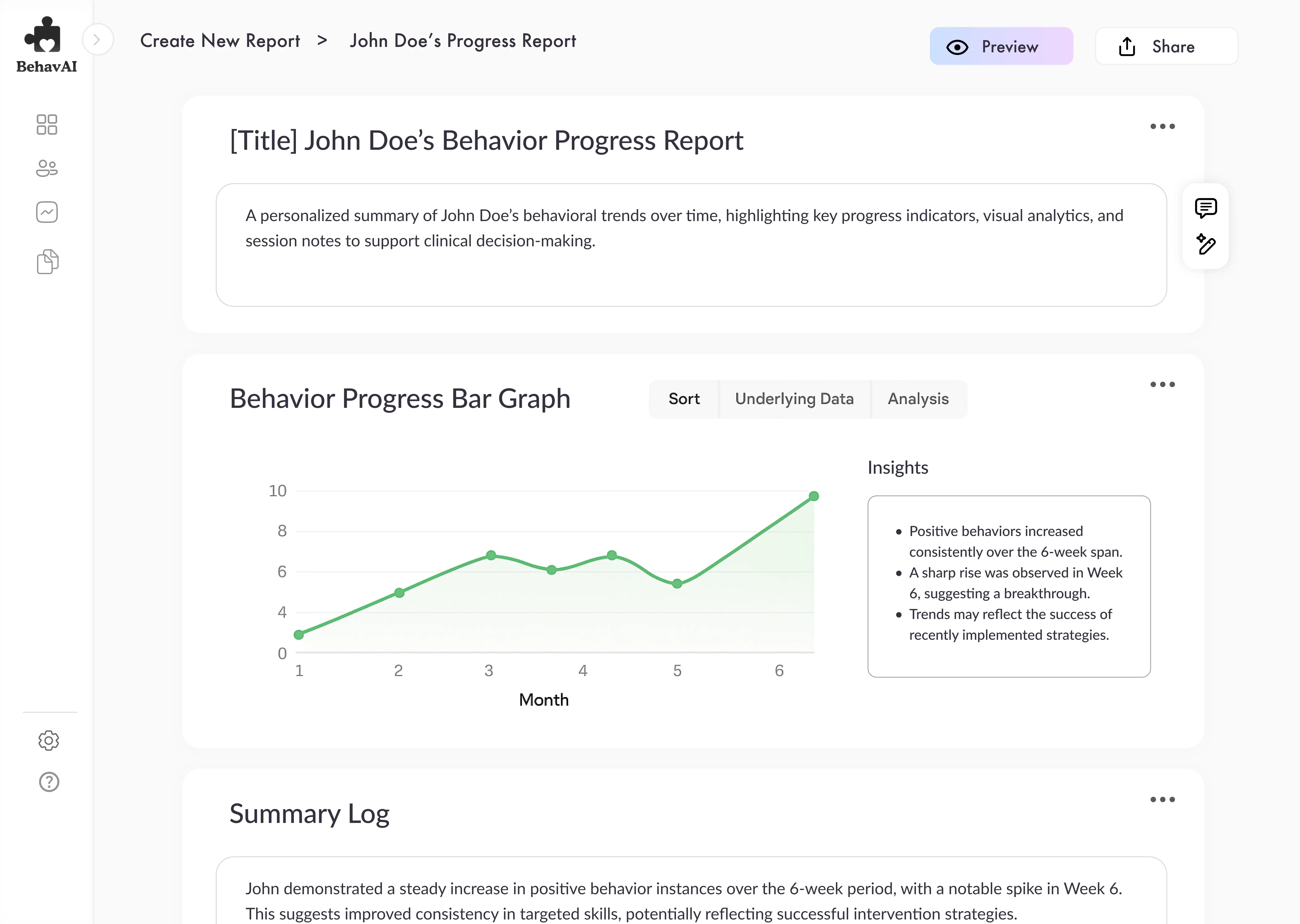 Clear division of control: AI suggests structure, provider decides contentSection-by-section editing helps BCBAs maintain their clinical voiceFlexible layout lets providers emphasize what matters for each unique clientDrag-and-drop structure gives full layout flexibilityRequires more upfront setup compared to automatic generationSlightly steeper learning curve for providers new to the platform
Final Solution
Take a closer look at how the platform turns raw session data into decision-ready reports.
1. Start from client data to draft a report
Client information and session notes are uploaded to generate a structured draft based on patterns across sessions.
2. Shape the report layout to match the story
Drag-and-drop sections adapt to each client's progress, emphasizing breakthroughs or ongoing areas of growth.
3. Analyze content with integrated AI assist
AI Insights surface trends across weeks of data to inform clinical judgment and support intervention strategies.
4. Share, review, and act on reports together
Reports can be previewed, annotated, and exported in formats suitable for families or clinical supervisors.
Impact & Traction
From a classroom idea to real traction in the ABA community.
BehavAI gained momentum quickly — winning 1st Place at Techstars Startup Weekend Pittsburgh out of 30+ competing teams, and being selected to demo at Carnegie Mellon's AI Venture Studio Demo Day .
More importantly, early conversations with clinicians showed strong demand for a tool that reduces documentation load and clarifies progress across teams.
 🥇 1st Place Techstars Startup Weekend 2025
“BehavAI can turn the data we already collect into regulation-ready reports (…) freeing more time for clients.”
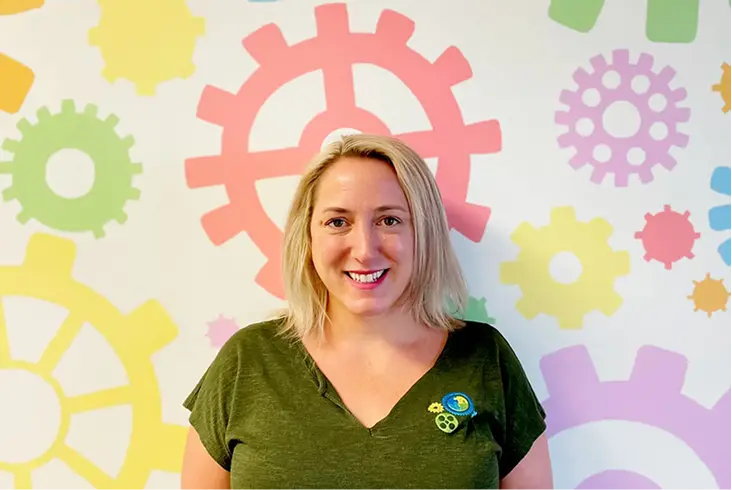
“BehavAI could transform how we monitor client progress (…) and help us catch issues much earlier across centers.”

Current Status
We've moved from a validated concept to a clinic-ready MVP with pilot testing on the horizon.
We've built a clinic-ready, HIPAA-compliant MVP, validated the core reporting workflows with therapists, and are now partnering with clinics for a closed beta. Next, we'll run live pilots to measure time saved per report and improvements in documentation quality.




Reflection
What this 0→1 journey taught me about designing for care work with artificial intelligence.
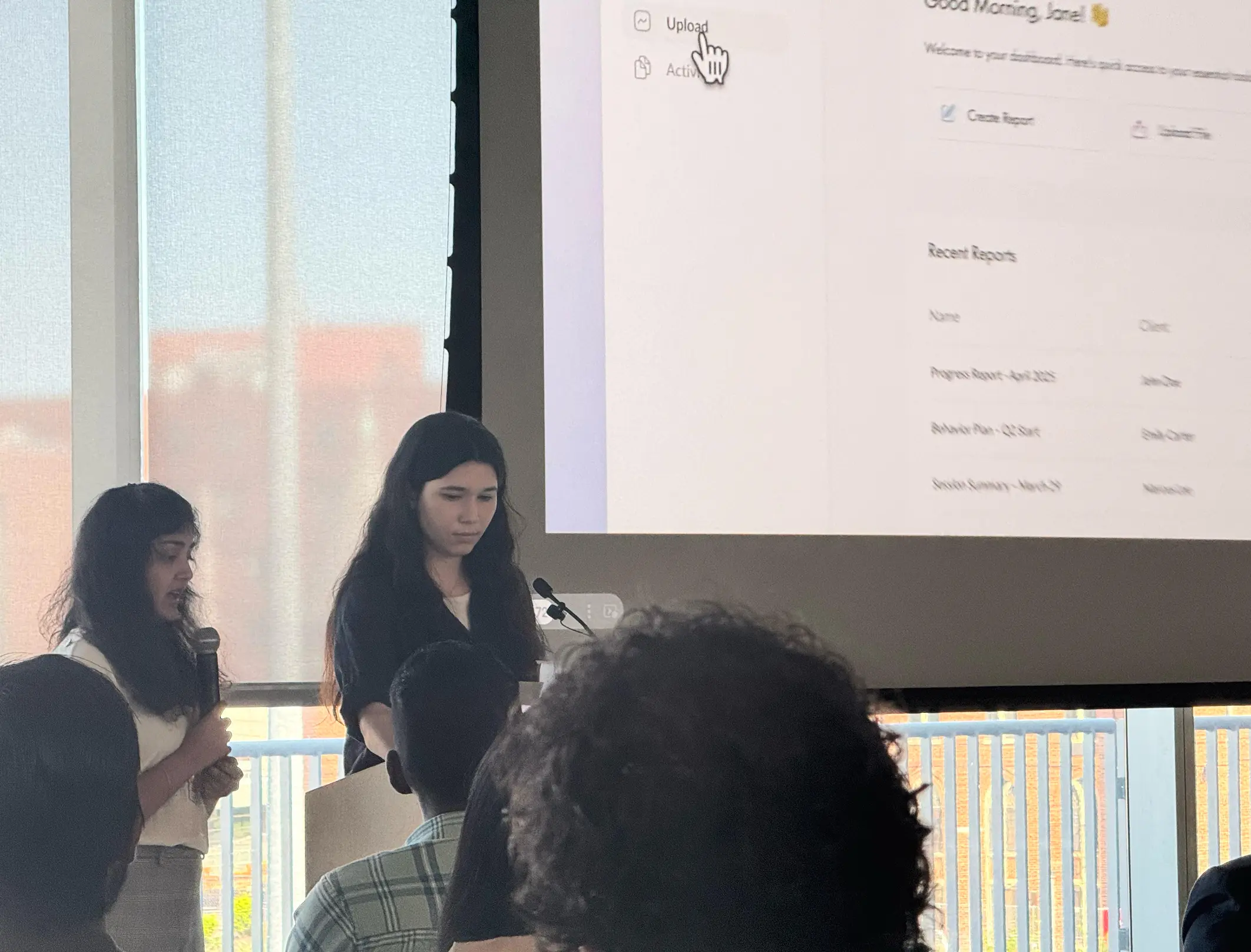
Us pitching BehavAI live at Demo Day!
Building BehavAI taught me how to design AI tools for a field where trust, accuracy, and empathy matter more than speed.
I learned how to work across ML, product, and clinical roles, how to turn messy workflows into clear interactions, and how to test with practitioners who carry real responsibility for real people.
More than anything, it reinforced that good healthcare design means listening closely and creating technology that supports human judgment instead of replacing it!